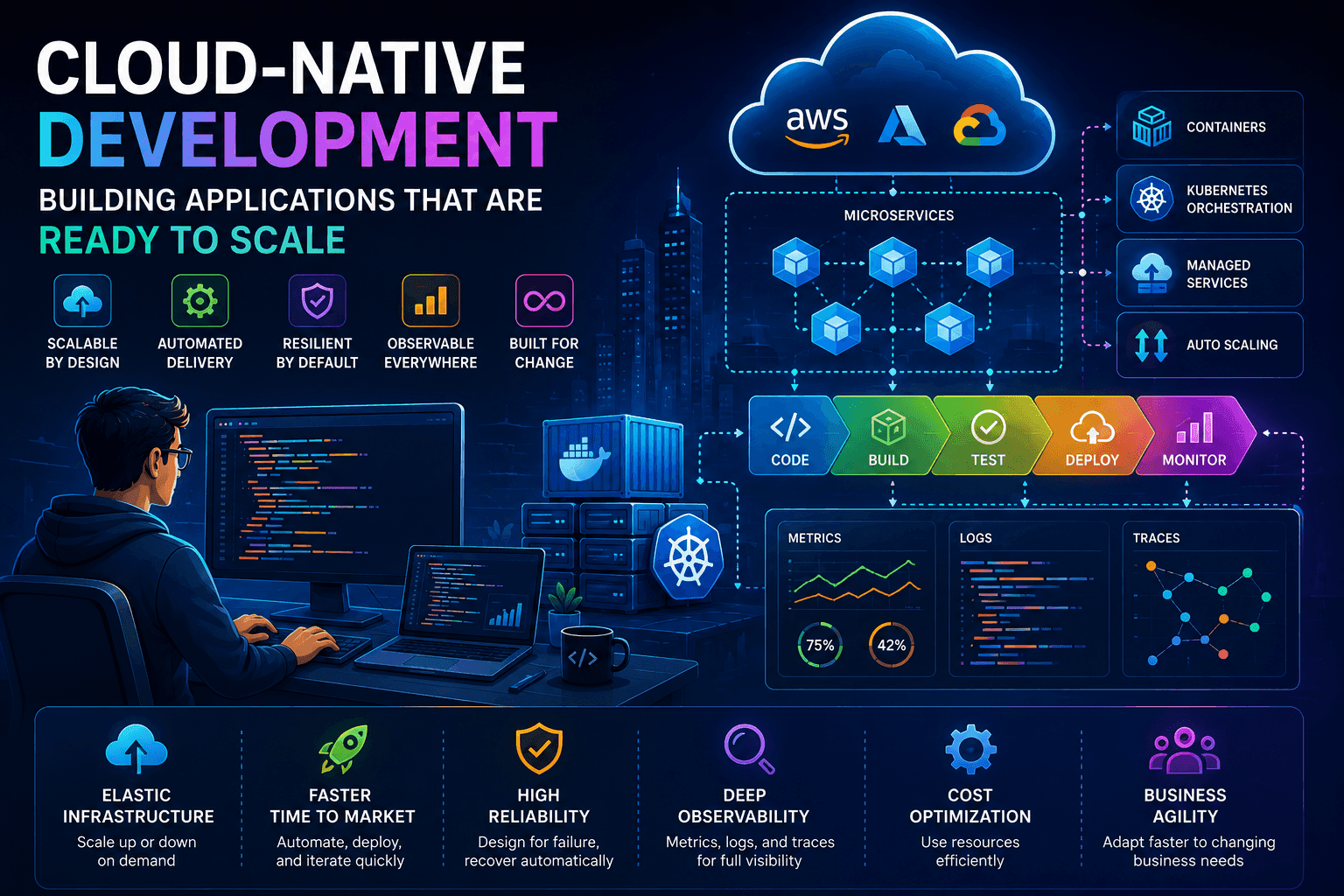
Cloud-Native Development: Building Applications That Are Ready to Scale
Modern applications are expected to support changing workloads, frequent releases, global users, integrations, and continuously evolving business requirements.
Cloud-native development provides an approach for designing applications that can operate effectively in these dynamic environments.
Being cloud-native, however, means more than simply hosting an application on a cloud server.
What Does Cloud-Native Mean?
A traditional application can be moved to cloud infrastructure without fundamentally changing how it is designed.
A cloud-native application is different.
It is designed to take advantage of capabilities such as elastic infrastructure, automated deployment, managed services, containers, orchestration, distributed architectures, and infrastructure automation.
The objective is to create applications that are easier to deploy, scale, recover, and evolve.
Containers and Consistency
Containers have become an important part of cloud-native application delivery.
They package an application together with the runtime and dependencies required for it to operate.
This helps create consistency across development, testing, staging, and production environments.
Instead of configuring every server manually, teams can build a container image once and deploy the same artifact across multiple environments.
Container orchestration platforms can then manage:
- Application deployment
- Automatic scaling
- Networking
- Application recovery
- Resource allocation
This enables teams to operate applications more consistently across increasingly complex environments.
Microservices — When They Make Sense
Microservices are frequently associated with cloud-native architecture.
They divide larger applications into independently deployable services, usually organized around specific business capabilities.
This can provide benefits such as:
- Independent scaling
- Smaller deployment units
- Clearer service ownership
- Greater flexibility for large engineering teams
- Independent development and deployment
However, microservices also introduce complexity.
Distributed communication, service discovery, observability, network failures, data consistency, deployment coordination, and infrastructure management all become more important.
For many applications, a well-designed modular monolith can remain the better architectural choice.
Cloud-native development is therefore about selecting the architecture appropriate for the problem rather than automatically adopting microservices.
Designing for Failure
Failures are inevitable in distributed environments.
Networks can become unavailable. Containers can restart. External services can fail. Databases can become temporarily unreachable.
Cloud-native applications should therefore be designed with failure in mind.
Common resilience techniques include:
- Health checks
- Controlled retries
- Timeouts
- Circuit breakers
- Redundancy
- Graceful degradation
- Automated recovery
- Continuous monitoring
The objective is not to create systems that never fail, but systems that can handle failures predictably and recover quickly.
Automation From Development to Production
Automation is another core principle of cloud-native engineering.
Application builds, automated tests, security checks, infrastructure provisioning, database migrations, deployments, and rollback procedures can all become part of controlled automated workflows.
This reduces dependence on manual deployment procedures and makes releases more consistent and repeatable.
Combined with Infrastructure as Code (IaC), organizations can recreate environments consistently instead of relying on manually maintained servers.
Observability Must Be Built In
As applications become distributed, understanding their behavior becomes more difficult.
Logging alone may not provide enough information.
Cloud-native applications should therefore be designed with observability in mind from the beginning.
Metrics help teams understand system health and performance.
Logs provide detailed information about application events.
Distributed traces show how individual requests move through different services.
Together, these signals allow teams to identify problems, understand application behavior, and troubleshoot issues more effectively.
Scalability Is More Than Adding Servers
A scalable application requires more than additional computing resources.
Database architecture, caching, asynchronous processing, API design, external dependencies, session management, storage, and application state can all affect scalability.
Cloud-native architecture encourages teams to evaluate these constraints early rather than waiting until an application experiences significant production traffic.
Applications designed with scalability in mind are better prepared to respond to growth without requiring major architectural changes later.
Building for Continuous Change
One of the most important benefits of cloud-native development is the ability to adapt.
Business requirements change, user demand increases, technologies evolve, and applications continuously require new functionality.
Cloud-native practices enable engineering teams to release smaller changes more frequently, scale individual components when required, recover from failures automatically, and evolve applications without rebuilding everything from the beginning.
This makes cloud-native architecture valuable not only for technical scalability but also for long-term business agility.
Conclusion
Cloud-native development is ultimately about building software that can adapt.
Containers, automation, managed cloud services, resilient architecture, observability, and scalable infrastructure provide teams with the foundation needed to operate modern applications reliably.
The right approach is not to adopt every cloud technology available. It is to select technologies and architectural patterns that make the application simpler to operate, easier to change, resilient to failure, and ready to grow with the business.